Looking back to move forward

The current image has no alternative text. The file name is: gratitude.jpg

‘Tis the time of year to feel gratitude and express it. Or so they say.

“But,” you counter, “With all the horrible things happening in the nation and around the world, and political conflicts in my family, the pressure of finding the right gift for Uncle Charlie, and telling grandma we’d prefer she not overcook another turkey, how could I possibly feel grateful?”

One answer comes from Gregg Krech, head of the ToDo Institute, an organization that focuses on “mental wellness and Japanese psychology.” Its newsletter is titled 30,000 Days (representing a lifespan of 82.19 years) and offers thoughts and examples of how best to live those days.

I, too, have moments of questioning the whole idea of gratitude every time I read a half dozen articles on the mess this country is in. Many days the news is just plain depressing. But Krech would probably say that one doesn’t look to the news to improve a mood. Rather, feelings of gratitude come from self-reflection, which can lead to changing our mindsets.

Every year around this time, ToDo offers a four-week, on-line program, “Gratitude, Grace, and A Month of Self-Reflection.” I signed up for this knowing I already had too many commitments, but thought I’d try to squeeze it in anyway.

Nearly every day, the agenda contains a recommended exercise, many of which I haven’t yet had time to do, but they’re waiting for me when the busyiness of this month slows down. 

Mostly, the assignments ask you to think hard about your actions and attitudes, an exercise that often points to our generally not paying attention or recognizing all the elements of the supportive world that surrounds us.

When we consider our lives, what we’ve done and are doing, we take much for granted, starting with all the people who’ve come into our lives outside our families and provided help, for example, a first grade teacher, a favorite boss, a helpful neighbor, a friend.

The next task is to think about objects that truly have a positive impact on our physical and emotional well-being. We encounter hundreds daily, but the exercise was to name only ten items we take for granted, such as a toothbrush, toaster, scissors, eyeglasses. We then moved to less visible factors that make our lives easy and healthy such as plumbing, electricity, fresh air, and water.

And these are just the first activities. Later ones require deeper thought such as one about a past accomplishment. This and other exercises call on you to recognize all the support you’ve been given but not necessarily acknowledged, while you also admit that you might have hurt, or at least inconvenienced, someone else along the way.

Despite my slowness in completing assignments, I think the program is starting to work, not every minute, not even every day, but every few days something strikes me as an opening of a door to recognizing a hidden blessing and feeling grateful.

Through this program, change comes down to spending time in self-reflection and discovering a different world than the one you thought you knew.
Posted in health, inspiration, support and caring, Uncategorized | Tagged , , , , , , , | 3 Comments

Music is good for just about everything

“While in my heart there swells a song,
       And I can sing.”

James Weldon Johnson

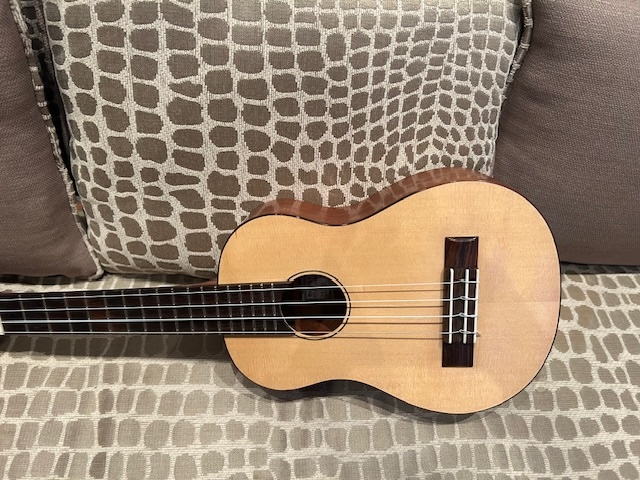
At last Sunday’s church service, our new ukulele group had its debut performance, which consisted of accompanying the audience’s singing of a gatha (Sanskrit for song or verse). As the sentence above should make it clear, we weren’t playing a solo and the audience was probably too busy singing to know if we made mistakes, yet for the players it was a satisfying experience. “We did it,” was our common reaction, partly said from relief that it was over, but also reported with smiles on our faces. That’s because making music with others has significant benefits.

Greater Good Magazine, subtitled, “science-based insights for a meaningful life,” offers this headline in its June 28, 2016, issue: “According to new research, music helps synchronize our bodies and our brains.”

my uke

And who doesn’t want days, or even weeks and months, when their bodies and brains work together?

“Researchers recently discovered that we have a dedicated part of our brain for processing music, supporting the theory that it has a special, important function in our lives.” (Greater Good)

“If it is a language, music is a language of feeling,” says the National Library of Medicine website. Playing music and singing are common experiences in many lives, from hearing our mothers singing to us as babies to being introduced to an instrument early in life. Many of my generation took piano or violin lessons in elementary school and many more have followed ever since.

Having been a member of an earlier ukulele group, I found playing music was a way to get to know people I’d never talked to before. And since at least one band member was a native Japanese speaker, playing music together offered a way to communicate. Playing in the newer ukulele band offers the same opportunity to get to know new people while learning new songs. 

The American Psychiatric Association website agrees that music can bring people from different cultures and life experiences together. “Music can also serve as a catalyst for social connection and support, breaking down barriers and bridging divides.”

Given our aging population, it’s also encouraging to learn that “music training for the elderly can be seen as a tool to delay cognitive declines.” I remember a friend saying his aging mother had stopped talking, but he was delighted that she could still sing.

I studied piano in elementary school and quit in seventh grade. My husband and I took lessons for many years as adults, but eventually lost our teacher. Our piano bench currently serves as a place to set things before taking them upstairs and the piano itself is an avid collector of dust. However, after reading about all the benefits of playing music, I’m convinced it’s time to get it tuned.

Posted in Uncategorized | Tagged , , , , | 2 Comments

Homage to Trees

“If you go down in the woods today, You’re sure of a big surprise.” Admittedly, “The Teddy Bears Picnic” was probably never considered for a Grammy, but in one sentence it expresses what many of us feel as we walk or hike through our local forests.

Lately, I’ve become obsessed with trees. They calm me and also create a feeling of awe. They’re a source of beauty and wonder, harbingers of changing seasons, possessors of fragrant scents, rainbows of color that alter with the seasons, and homes for birds, squirrels and other creatures.

Trees also have a lot to brag about. The oldest tree in the world is in California and is estimated to have lived for 4,858 years… so far. California also boasts the largest “single stem” tree on earth. The General Sherman Sequoia stands 275 feet tall with a base of 36 feet in diameter. The town of La Conner, WA has a cross section of an eight hundred year old Douglas Fir with tags stuck to different rings showing dates of events around the world starting with the Magna Carta in 1215.

Trees are good for us in many ways, most obviously in absorbing carbon dioxide and releasing oxygen. But what about psychological benefits?

The local botanical garden newsletter, “The Buzz,” has an article in its October edition on “The Healing Power of Nature,” by Jayce Grant.

Grant says, “Surveys show Americans spend about ten hours a day looking at screens, while the average time outdoors is just thirty minutes. But how much of those outdoor moments are spent running from the car to the store, mowing the lawn, or taking out the garbage for pickup. Time in nature maybe, or not.

Grant’s recommendation to escape this trend is to get outside and into the forest. She’s not the first to suggest this. The Japanese concept of “shinrin-yoku” or forest bathing has been around since 1982. This doesn’t refer to a literal bath but to immerse oneself in the colors, smells, and sounds of a forest. 

And while the research can’t say conclusively that spending time in the woods will turn you into a picture of good health, one review of all the existing studies says, it helps reduce stress, lowers heart rate and blood pressure. And Chat GPT agrees.

Anyone who has tried forest bathing is aware of the benefits including exercise, fresh air, and the absence of screens and doomscrolling. It uses all the senses: scents from flowers; sounds of croaking by frogs, birdsongs, and the winds sailing through the trees; the touch of raindrops in the winter; and sights of birds, deer, and flowers. And we don’t need research to tell us we feel stronger, calmer, and relaxed – or worn out – after a walk through the woods.

As you immerse yourself in the forest, it’s best to ignore the rest of the lyrics to the teddy bear song.

“If you go down in the woods today,
You’d better not go alone.
It’s lovely down in the woods today,
But it’s safer to stay at home.”

Posted in Uncategorized | Tagged , , , , | Leave a comment

“Will your life measure up?”

Ponce de Leon never found the Fountain of Youth. Can current-day billionaires achieve what he couldn’t?

Lately, I’ve been fascinated with reports about billionaires devoting themselves and their fortunes to the quest of a longer life. An article in the August 11 New Yorker talks about the moves these men are making to realize their dreams of encountering a personal Fountain of Youth.

Leading or engaging with groups with such titles as Don’t Die, Healthspan, and Fountain Life. the objective of these men is not just to stick around for a very long time, but to live in a body that’s escaping arthritis, cancer, and other impediments to comfortable longevity. The goal for some is to at least double the current average lifespan, which is now seventy-seven for men. These articles don’t mention women, who’s average lifespan is eighty-one, except in the context of needing to replace them with ones able to provide the old men a chance to enjoy their great, great, great, great great grandchildren. In other words, “Bye Bye Baby.”

Despite the billionaires’ enthusiasm and determination to quickly solve the problem of natural death, the obstacles are great. Given our forty trillion cells, in many situations one problem is solved while another is created. Quoting from several New Yorker paragraphs, “For biohackers”*, an antibiotic called Rapamycin inhibits the senescent cells that cause inflammation, but having too few senescent cells is dangerous because these block tumors.” Research is unclear about many things. And some of the products being sold sound like the work of snake oil salesmen.

What’s most interesting is that some of the men are devoting their days to every imaginable protective treatment so they can live longer. They take huge quantities of supplements, fill their veins with “young” blood, engage in different therapies, act as guinea pigs with various elixirs, and cut calories significantly, in one case to 1977 a day. (Google says “Most adult men require between 2,000 and 3,200 calories daily.) They’re also measuring their internal organs to determine whether the ages of different organs match their chronological ages.

Maybe the billionaires are right that in time humans will live much longer and their research will show the way, but I have many questions about this new frontier. For this blog, I’ll just stick to one. Is spending one’s life doing daily monitoring of every aspect of one’s body considered living?

*playing with genetic research material free from concerns about ethics

Posted in Uncategorized | Tagged , , , , | 3 Comments

AI: ghost in the machine ?

AI is messing with me.

Here’s my evidence.

Last week, using my early attempts at dictating* a scene for a mystery novel (a joint project with a friend), I ended up with about five pages of text.

I highlighted a few paragraphs and in an instant the words on those paragraphs changed. I have no idea what I clicked or didn’t click, but an AI must have gotten ahold of my words and turned them into something different. Sadly, the moment I read them I thought AI’s words made for more interesting reading.

The current image has no alternative text. The file name is: thinking_8488980.png

I rushed to notify members of my writers’ critique group that I was retiring. AI won!

They, of course, talked me down off the cliff. Several people criticized AI writing as being wooden and one even created a list of what AI stood for, including Arguably Insane, Achieving Infamy, and Appropriately Inebriated.

But yesterday, when I began to write this blog, I decided to submit new paragraphs for AI to transform and nothing happened. I could not convince Microsoft’s Co-Pilot to make any changes.

I had no idea how AI got involved earlier, but I can show you the outcome. I don’t have my original scene, but it started something like this:

Greta takes long strides and quickly covers the ground between the Drumholz farmhouse and the mainstage, which is where she’s been told Terry is working. She wants to catch him before he runs off to the other stage, a concession stand, or even the portapotties. Today, her time is as valuable as his. 

More follows about Greta climbing onto the stage, encountering Terry, musicians, and enough items on the stage to cause her to stub her toe.

AI changed it to this:

Her thick boots thud against the grass, the air thick with festival buzz and distant laughter. Greta scans for Terry — a fleeting figure in a red ball cap — threading between amps and sound cables. She presses forward, weaving through technicians rolling cases and volunteers clutching walkie-talkies. The sun hangs low casting angular shadows across the wooden plans of the MainStage and Greta feels the pinch of urgency in her chest.

AI knew more about music festivals than I do. (I’m lucky to have a co-author who knows more than AI.) And it added more setting and punchier language.

But wait! That isn’t the end. Today, I remembered that months ago Co-pilot had been driving me crazy wanting to take over every paragraph and I had disengaged it, so I re-engaged it, highlighted a new paragraphs, and asked it to add more punch.

Eager to see my new and improved writing, I was taken aback by AI’s next communication, which was that it would never rewrite something for me without my permission. But this is exactly what it did two days earlier, when it was supposedly disengaged. I proceeded to post my new paragraphs and asked for suggestions for improvement.

Example of new AI’s pathetic attempts: Original: She (Sergeant Greta) knows Terry’s responsible for festival operations and hates to get in his way, but it’s best to grab him before he runs off and she can’t find him again for hours. Also, she has a reputation to protect. Twenty years have passed since she stood him up for their senior prom and a few guys are still talking as if she’s a ball-buster, when all she did was respond to a better offer in high school. Odd as it seems, the label pleases her when she’s dealing with a handful of troublemakers. Enhanced: Aware of Terry’s pivotal role in festival operations, she loathes interrupting him but knows it’s best to catch him before he vanishes for hours. She also has a reputation to uphold. Twenty years since she stood him up for prom, some still label her a ball-buster, though she merely accepted a better offer. Strangely, the label suits her when handling troublemakers.

This AI, in contrast to the earlier one, refused to rewrite part of a scene without asking my approval. And it could only come up with a couple of new words. And the new writing was wooden. Where is the AI that was a better writer?

This experience led me to ask what I was dealing with, an AI or a ghost in the machine?

Whatever happened convinced me that I shouldn’t retire from writing, not quite yet. Next step is to disengage AI assistance again. Maybe when it thinks no one wants its help, it will return to better rewrites.

*See earlier blog, “Dictation.”

Posted in Uncategorized | Tagged , , , , | 4 Comments

Dictation

About ten days ago I subscribed to a blog about writing, and then began receiving emails from the blogger, Sarah Elizabeth Sawyer. The emails highlighted her mission to convince writers to dictate their novels, rather than compose them by fingers on a keyboard.

(By Holger.Ellgaard – Own work, CC BY-SA 3.0, https://commons.wikimedia.org/w/index.php?curid=5706078)

I never considered trying this, and it was not something I could imagine doing, since I’m accustomed to staring at a screen, writing a few paragraphs, reading them, making changes, reading them again, making more changes, and setting the words aside until the next day when I reread and make more changes.

Dictation frightened me. How could I ever spit out a paragraph without writing it first and then reading it aloud? And, why would I want to try?

I did have one reason to make a change. It’s called aging. A younger friend and I are writing a mystery. We started in 2023. My goal is finish our mystery, which is a cross between a cozy and a whodunnit and a comedy. It’s embarrassing to admit how long the process is taking. I just had a birthday and would like to finish before I’m too old and drifting into my own twilight zone.

This pressure led me to sign up for a free lecture on the process of dictation. Sawyer’s key argument was that dictation is fast. While the speed angle is a good one, I’m skeptical I can dictate intelligible scenes quickly, but still curious to learn how dictation works. Her thirty-minute presentation was followed by a fifteen-minute sales pitch, after which I decided to sign up for her package. How could I not? It was going for half price!

While signing up for this program was indeed impulsive, it wasn’t the same as responding to unwanted texts asking me to take care of my unpaid toll bills or postal service complaints that they don’t have my correct address. Hmm. The toll bills were from the east coast, where we don’t live. And we’ve been at the same address for nearly fifty years and the postal service has no problem delivering the junk mail.

My point is I can distinguish between scams and come-ons, though it’s obvious that I can be easily persuaded by a come-on.

After paying my money, the next few steps I took made me question my involvement with this program. The first lesson covered recording tools and transcription services. My research on these left me in a complete muddle and scared that I would have to spend more money than I expected.

A few days later I had a one-on-one session with Sawyer who showed me that I could easily record on my laptop and phone and watch as my spoken words printed immediately into a Word document.

My current assignment is to write Morning Pages* for five consecutive days. This involves getting up early and dictating three pages of whatever comes to mind. They don’t have to make sense. You just have to keep writing, or in my case, talking. A writer friend has been writing Morning Pages for years. It’s a habit she developed many years ago to which she is still committed. I read another testimonial saying “Morning Pages changed my life.” I wonder how many days of getting up early and rambling into my computer are required before this can happen.

I’ve been dictating Morning Pages the past four days. The only change in my life so far is that I’m sleepy by mid-afternoon, but I am getting comfortable with dictation even if much of what I dictate makes no sense. And talking to a machine before my day gets going has been a positive experience, especially considering the alternative is reading the day’s news.

The next assignments in the course are supposed to change your brain. Not sure what that means, but I look forward to finding out.

Posted in Uncategorized | Tagged , , , , | 2 Comments

What day is it?

After taking a walk this morning, a friend and I were sitting on a bench outside a woodland cafe enjoying our hot drinks when she mentioned that she needed to clean out her garage and get rid of boxes and boxes of paper, including old tax documents.

“Paper,” I shouted, startling the sparrow pecking the ground around us. “Shredding. Today is the county’s paper shredding day at the high school. It closes at noon. What time is it?”

It was 10:45, and though the announcement said the service would be available until noon, it warned that it would close sooner if the site received all the paper it could handle before then.

I rushed home and alerted my husband that today was the day to get rid of bags full of old bank and credit card statements, and medical records. Earlier, I’d planned to lump this with another exciting adventure for the same day, namely, moving bags of old clothing, kitchen utensils and other items to a nearby thrift store. I touted it as two garage cleanups for the price of one trip. If you saw the garage you might question how removing a few sacks could be called a cleanup; still, every little effort counts. Admittedly, at our present rate of cleanups, the garage might need a bit more time, say, three years.

As we rushed to the high school and drove around the front parking lot, I wondered why there was nothing pointing us to the spot. It’s a big school with multiple entrances. Surely, the county would have prepared bold signage.

As we cruised the empty parking lot, my husband said, “This is Friday. Are you sure that’s when the shredder was coming?”

I greeted him with silence. What could I possiblly add to that? Of course, the event was scheduled for Saturday. I had a good excuse for the mistake, aside from possible dementia, because I usually walk with this friend on Saturdays.

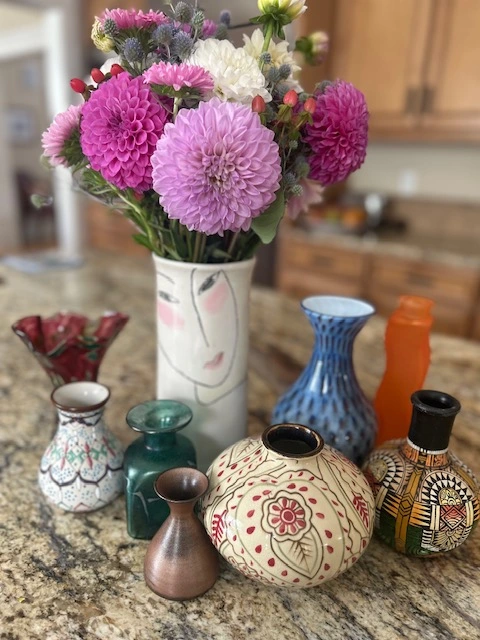
But the whole event did set me thinking about all that we accumulate in the days and years of our lives, just bringing one or two non-perishable items at a time into the house for months, then weeks, then years. A few days ago, I went searching in a cupboard for a vase for flowers I’d brought home from the farmer’s market, I thought back to many years earlier when a friend and I used to comb through thrift shops across two counties looking for interesting vases for flower arrangements. Not that long ago, I gave away at least half of my vase collection. So why do I still have twenty-one left?

The Google AI says, “On average, an American household contains an estimated 300,000 items, according to the LA Times. This is despite the fact that many Americans have homes with more space than previous generations, with the average home size nearly tripling in the last 50 years.”

It looks like those of us in the senior age range have to do more than drop off a few pieces of clothing or cookware at the thrift shop every year or so. If we only want to get rid of half our stuff in a year, we’d have to find homes for two thousand eight hundred seventy items a week, more if you consider Friday and Saturday as one day.

Posted in Uncategorized | Tagged , , , , | 6 Comments

“Summertime”

Recently, several friends suggested I return to blogging after a two-year lull. I quit because after staying home for months, as Covid fears began to fade, I ran out of anything to say beyond, “Yea! I can go to the grocery store without wearing a mask.” As time passed, my world seemed to be mostly limited to grocery stores. And I ran out of anything to say.

But my friends persisted. “When you’re with us, you talk all the time. It shouldn’t be too difficult. Also, we liked reading your blogs, because they were informative,”

‘Informative’ was never my intent,” I thought. But why not. Just because I’m working on co-authoring a whodunnit with a friend, and sitting in front of the computer cursing at Duolingo to improve my Spanish, why not spend a few more hours hunched over a computer and further rounding my shoulders. Anyway, I’m giving blogging a try again. I chose August 1 to start because it marks a new month and a new year — another one– for me. And I see August as a lazy time, a period when no one is working too hard. At least no one around me. Maybe that’s because we’re all old.

I just hope my followers from before are still alive to greet me.

“Summertime and the livin is easy.” No fish are jumpin’ and there’s no cotton growing here, though a lovely crop of tiny and mid-sized tomatoes in pots in the back yard are starting to turn the appropriate color for their particular variety. Maybe my living is too easy. Except in the area of cooking. After meal planning and cooking for many, many, many years, even with my husband’s able assistance, I find our meals often uninspiring. Restaurants aren’t a lot better. Maybe some chefs are bored with their cooking too. This makes my biggest daily challenges to be deciding what to eat and then preparing the meal.

So, August will be the month of salads. Not your everyday bowl of torn up lettuce leaves, topped with a few tomato bits, the equivalent of a loaf of bread in the form of croutons, brought to a climax with a bottle of dressing slobbering all over it. No, I’m choosing recipes from the New York Times and other illustrious sources, ones that call for hard-to-find ingredients you’ve never heard of, ones that you use only once after you’ve tried the recipe and decided it wasn’t worth the effort to do it again. And now your kitchen cupboards are filled with the useless ingredients you’d feel guilty throwing out, so you hold onto them until you begin to see grayish-green spots within.

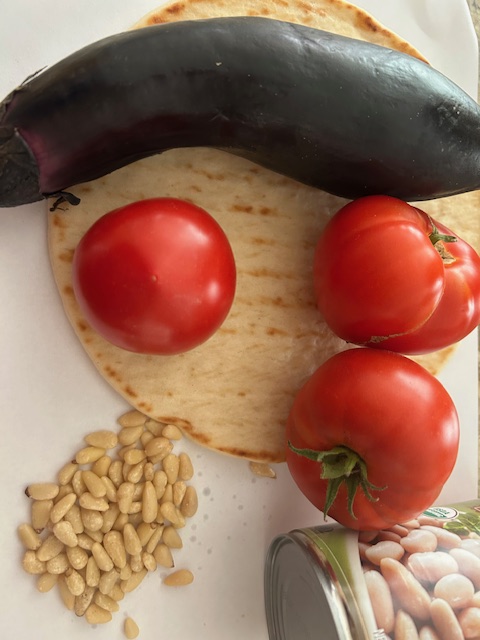
What kinds of salads am I talking about? Salads with a Persian cucumber (what’s that?), toasted pine nuts, grilled eggplant, sliced jicama (where the salad calls for one tiny slice and you’re left figuring out what to do with the rest of it), one small daikon, and one-half, small napa cabbage. At the Asian grocery store where I sometimes buy my vegetables, I can assure you, they’ve never heard of a small napa cabbage.

Tonight’s menu will involve roasted eggplant, torn-up toasted pita and a few other ingredients not usually associated with salads. All to accompany a Costco chicken.

My hope — and I’m certain yours too —is that returning to the blog will open a few more doors to other topics to consider for the future.

Posted in Uncategorized | Tagged , , , , | 11 Comments

Oh, do they want your feedback

Dawn Huczek, Creative Commons Attribution

“How did we do?”

The question might come from your doctor or dentist, your bank, credit card company, and any other organization you do business with.  They all want your feedback.  Sometimes the request is to click on a series of stars, five being the highest ranking. Other times it’s “only a two-minute form to help us improve customer satisfaction.”

I received the latter last week after spending eight months writing letters to ask a credit card company for a card, the one they didn’t send when an earlier one expired. I wrote to them, because by the time I got around to following up on the problem, a simple call to a credit card robot would have been very complicated. After several letters, the company understood part of the problem, so I felt more confident calling.  I asked for a Live Agent, and was told by a representative of the living dead that I didn’t need to talk to a live being, because it could do the job of a human. Eventually, I successfully babbled my way to help. And wonder of wonders, I received the help I wanted from the Live Agent. A week later, I received the credit card that had been denied me for nearly a year.

And now the company wanted to know how they did. Where to begin? How to explain in a form requiring only two minutes of my time that I had used at least two hours to achieve this satisfaction. I deleted the request.

And then there are the long surveys that ask the most personal questions on the topic, “How are you doing?”  Last winter, I received a multi-page booklet of questions from Nielsen ratings and one dollar bill to answer them.  The recycling bin got the tome and I got the dollar. A few weeks later another copy of the booklet and another dollar arrived, resulting in the same outcome as the first.

I have two stories about recent surveys my husband and I received.  First, a friend from out of town, called me last week using Messenger. She’s a blogger and when we lived in the same city we met weekly for coffee and encouraged each other in our efforts.  She worked in public relations, as did I, before retirement. We had a short conversation about the topic of “How are we doing?” surveys and how our former employers should have conducted a few, and then moved on to other subjects.  When the call ended – I’m not making this up – six stars appeared on my screen asking me to click and evaluate the experience. To rate a personal phone call???

In the second case, my husband bought wild bird seed and ant killer at a local hardware/building supplies store. He received requests to rate both products. Thus far, the ants have been silent, and there is only one answer from the birds: cheep, cheep, cheep.

Posted in current events/themes, humor | Tagged , , | 6 Comments

My three-cents worth

I love what is known, quaintly, as “customer service.” I’m old enough to vaguely remember that at one time it involved dialing a company’s phone number, and being greeted by someone who wanted to help by answering your question or concern.

Customer service is different now. Here’s how I know.

I owe three cents for accidentally underpaying my August cell phone bill on-line. First, the company sent notification of this debt via text, and then followed it by mailing a paper copy of the bill.

My first thoughts were: Couldn’t this payment wait till next month, when it could be attached to a larger bill? Followed by, Do they really expect me to write a check or use a credit card for three pennies?

Then I started to think about what would happen under normal circumstances if I didn’t make at least a partial payment of a bill. I’d be paying more interest. In this situation, would I owe twice as much next month, say, six cents instead of three?

I asked the question of my search engine, where I received the startling answer. By not paying my bill, my service could be blocked and my phone shut off.

Would my credit score drop too?

I had to get these answers, so I called the customer service number on my bill. An AI bot answered and gave me choices of buttons to push, “Press one if you want to know whether you paid your last bill.” Not helpful. I know I missed my payment by three cents. “Press two if you want to buy a new, outrageously expensive phone with much higher monthly service fees, three if you want to purchase an insurance policy for a phone or anything else, four if you wish to apply for a loan, five if you’re not yet discouraged, and six to be disconnected.”

Not liking any of the choices I said, “speak to a human.” That led the AI bot-in-charge to repeat the list of options it had just shared. 

I’ve been told that saying “operator” in situations like this would get me to a human, but, so far, I’d heard no evidence that humans worked for this company. Instead, I decided to garble my words and frustrate the AI bots as much as they were frustrating me.

Success.

“Would you like to speak to a live agent?” the AI bot asked.

So that was the secret. The agents didn’t have to be human, they just had to be live.

I had a hard time understanding the live agent, and she had trouble understanding me. Her English was shaky and my ability to speak whatever first language she spoke was shakier. Apparently, my situation was not one she’d faced before. It seemed that most callers expressed concern about the size of their bills and would have been delighted if only three cents were involved. Eventually we agreed (I think), that the three pennies would be added to my next bill. It only took an hour from beginning to end to resolve the issue and for me to get my three cents worth.

Next, I have to call a credit card company. I wonder if “live agent” will work with their bots. I think I’ll wait a few days to tackle that one.

Posted in humor, memories, technology | Tagged , , | 2 Comments